---
title: "featureform"
type: "tool"
slug: "featureform-featureform"
canonical_url: "https://www.graphcanon.com/tools/featureform-featureform"
github_url: "https://github.com/featureform/featureform"
homepage_url: "https://www.featureform.com"
stars: 1982
forks: 108
primary_language: "Go"
license: "MPL-2.0"
categories: ["developer-tools", "data-retrieval"]
tags: ["data-science", "ml", "embeddings", "ml-ops", "feature-store", "python", "feature-engineering", "data-quality"]
updated_at: "2026-07-07T18:45:41.908052+00:00"
---
# featureform
> Virtual Feature Store
Featureform is a virtual feature store that enables data scientists to define, manage, and serve ML model features without changing existing infrastructure.
## Facts
- Repository: https://github.com/featureform/featureform
- Homepage: https://www.featureform.com
- Stars: 1,982 · Forks: 108 · Open issues: 129 · Watchers: 13
- Primary language: Go
- License: MPL-2.0
- Last pushed: 2025-07-03T19:09:35+00:00
## Categories
- [Developer Tools](/categories/developer-tools.md)
- [Data & Retrieval](/categories/data-retrieval.md)
## Tags
data-science, ml, embeddings, ml-ops, feature-store, python, feature-engineering, data-quality
## Related tools
- [ECC](/tools/affaan-m-ecc.md) - The agent harness performance optimization system (★ 226,962)
- [AutoGPT](/tools/significant-gravitas-autogpt.md) - AutoGPT: Build, Deploy, and Run AI Agents (★ 185,417)
- [prompts.chat](/tools/f-prompts-chat.md) - The world's largest open-source prompt library for AI (★ 165,019)
- [transformers](/tools/huggingface-transformers.md) - 🤗 Transformers: the model-definition framework for state-of-the-art machine learning models (★ 162,347)
- [JavaGuide](/tools/snailclimb-javaguide.md) - Snailclimb/JavaGuide: 面试 & 后端通用面试指南,覆盖计算机基础、数据库、分布式、高并发、系统设计与 AI 应用开发 (★ 156,863)
- [langflow](/tools/langflow-ai-langflow.md) - Langflow is a powerful platform for building and deploying AI-powered agents and workflows. (★ 151,298)
- [firecrawl](/tools/firecrawl-firecrawl.md) - The API to search, scrape, and interact with the web at scale. (★ 147,117)
- [browser-use](/tools/browser-use-browser-use.md) - 🌐 Make websites accessible for AI agents. Automate tasks online with ease. (★ 103,315)
## README (excerpt)
```text

# What is Featureform?
[Featureform](https://featureform.com) is a virtual feature store. It enables data scientists to define, manage, and serve their ML model's features. Featureform sits atop your existing infrastructure and orchestrates it to work like a traditional feature store.
By using Featureform, a data science team can solve the following organizational problems:
* **Enhance Collaboration** Featureform ensures that transformations, features, labels, and training sets are defined in a standardized form, so they can easily be shared, re-used, and understood across the team.
* **Organize Experimentation** The days of untitled_128.ipynb are over. Transformations, features, and training sets can be pushed from notebooks to a centralized feature repository with metadata like name, variant, lineage, and owner.
* **Facilitate Deployment** Once a feature is ready to be deployed, Featureform will orchestrate your data infrastructure to make it ready in production. Using the Featureform API, you won't have to worry about the idiosyncrasies of your heterogeneous infrastructure (beyond their transformation language).
* **Increase Reliability** Featureform enforces that all features, labels, and training sets are immutable. This allows them to safely be re-used among data scientists without worrying about logic changing. Furthermore, Featureform's orchestrator will handle retry logic and attempt to resolve other common distributed system problems automatically.
* **Preserve Compliance** With built-in role-based access control, audit logs, and dynamic serving rules, your compliance logic can be enforced directly by Featureform.
### Further Reading
* [Feature Stores Explained: The Three Common Architectures](https://www.featureform.com/post/feature-stores-explained-the-three-common-architectures)
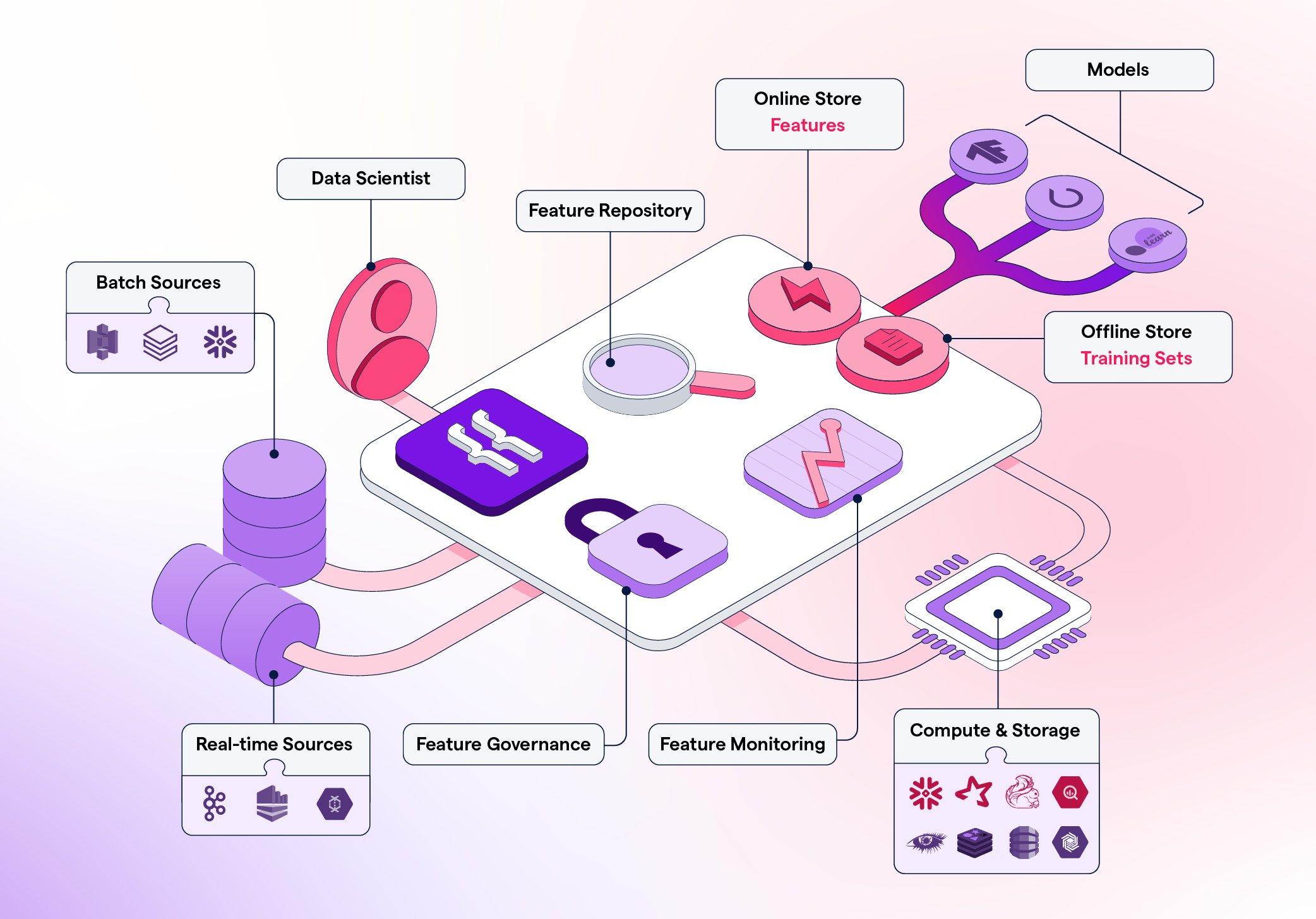
# Why is Featureform unique?
**Use your existing data infrastructure.** Featureform does not replace your existing infrastructure. Rather, Featureform transforms your existing infrastructure into a feature store. In being infrastructure-agnostic, teams can pick the right data
```
---
**Machine-readable endpoints**
- JSON: [`/api/graphcanon/tools/featureform-featureform`](/api/graphcanon/tools/featureform-featureform)
- LLM index: [/llms.txt](/llms.txt)
- Full corpus: [/llms-full.txt](/llms-full.txt)
_GraphCanon - The knowledge graph for AI development. https://www.graphcanon.com/_